Astrobiology Revealed #33: Lauren Mc Keown
on dendritic “lake stars” and Europan “spiders”
by Aubrey Zerkle
For this Q&A, we asked Lauren Mc Keown about her recent paper, “Lake Stars as an Earth Analog for Europa’s Manannán Crater Spider Feature.” Lauren is an assistant professor of planetary science at the University of Central Florida. She describes how dendritic lake stars may explain similar features on Europa, and how other niche environments on Earth could serve as powerful analogues for planetary processes beyond our world. (This interview has been edited for length and clarity.)

Everything about your recent paper in The Planetary Science Journal is fascinating... from spiders on Europa to lake stars on Earth! Let's start with the Manannán crater “spider” on Europa. What is this feature, and what is its general significance from a habitability perspective?
Thank you very much! The “spider” feature in Manannán crater is a radial pattern of lines that extend outward from a central point, giving it a spider-like or asterisk-shaped appearance. The feature lies in a ring-like pit, suggesting it may have formed due to brine pool activity beneath the surface, as originally suggested by Steinbrugge et al. Features like this are exciting because they may record interactions between Europa’s icy surface and subsurface liquid water.
From a habitability perspective, anything that suggests material exchange between the surface and the subsurface is important. Europa’s ocean is one of the most promising places to look for life beyond Earth, so features that might record past liquid water activity help us understand how accessible subsurface liquid water might be.
In the paper, you proposed that these features formed via a process similar to dendritic "lake stars." What are lake stars, and where else are they found in our solar system?
Lake stars are star-shaped or dendritic patterns that form on ice-covered lakes on Earth after a snowfall. They form when relatively warm water flows up through a weak spot in the ice on a frozen lake. That water spreads outward beneath the snow that has fallen on top of the ice, melting channels that branch outward in a radial pattern. This creates the characteristic “star” shape, and eventually the ice freezes, preserving the clearer melted pattern in the ice.
On Earth, they’re most commonly observed in snowy regions. For example, I have observed them in Colorado, and my collaborator, Victor, has studied them in Rhode Island. Many others have studied them in Alaska, and colleagues have observed them in Europe. While we haven’t yet directly observed lake stars elsewhere in the solar system, similar dendritic or radial patterns have been identified on icy bodies such as Mars (although these formed by quite a different process). If liquid water flows through granular ice with sufficient volume and flow rate, under adequate atmospheric conditions, it is plausible that we may detect other features like this elsewhere in the Solar System.
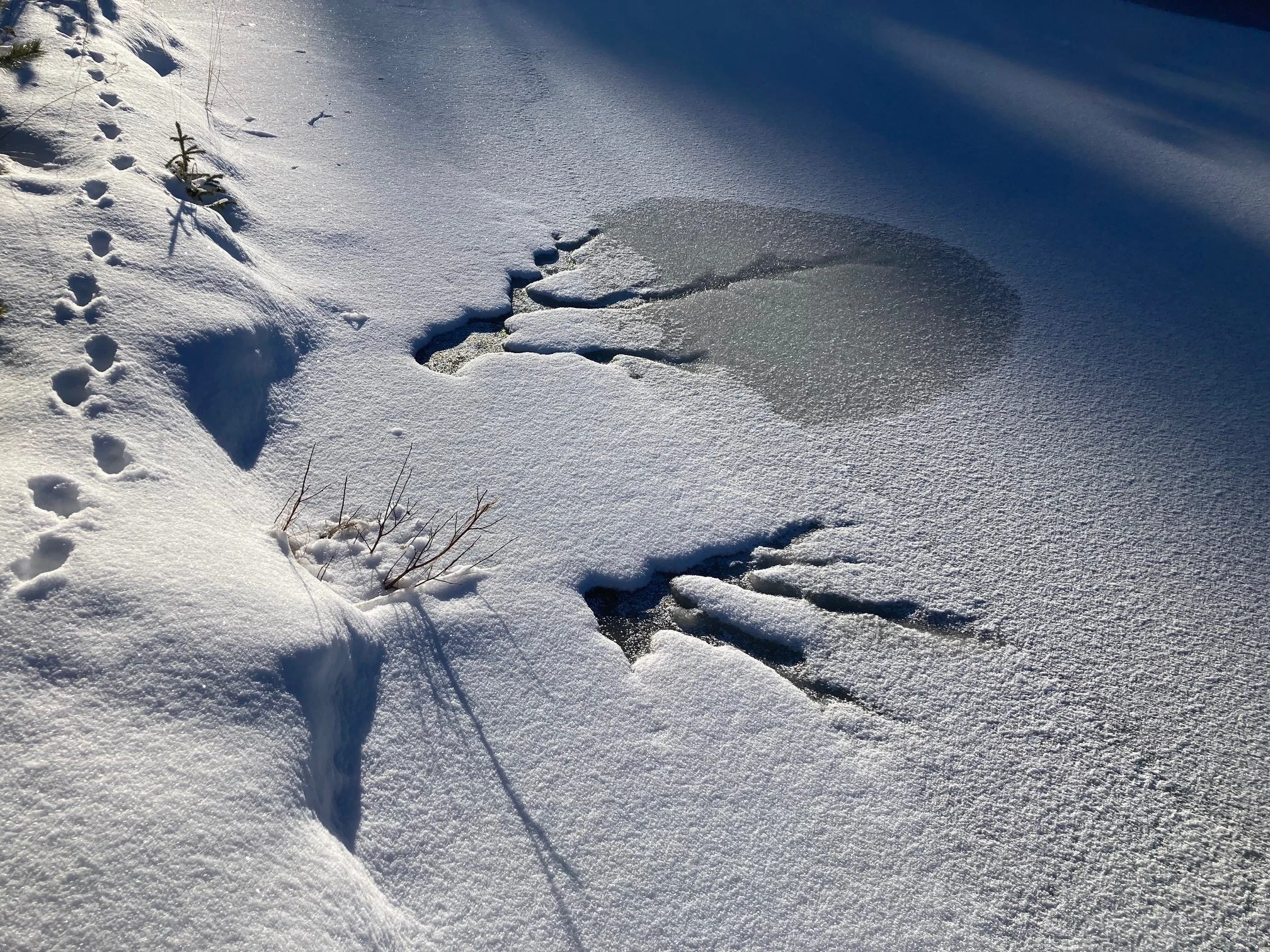
Lake stars at Breckenridge, Colorado. Photo by Lauren Mc Keown.
If the “spider” on Europa formed from a similar process, does that make it more or less interesting to astrobiologists and planetary scientists?
If the Europan spider formed similarly, that makes it more interesting, not less. It suggests that liquid water was involved and potentially mobile at the surface of an airless body after impact. Of course, some mechanism would have been needed to sustain water in the liquid state - a transient localized atmosphere or a big cloud of gas in the vicinity locally elevating pressure, elevated salt concentration acting like anti-freeze, and vaporization of water upon surfacing could all have contributed to sustained flow of liquid water. Most likely, such a process would occur underneath an icy surface crust, similar to how lava flows on Earth.
For astrobiologists, the idea that Europa’s ice shell may allow localized exchange processes is key, as these could transport nutrients or energy - essential ingredients for life.
You supported this hypothesis using field observations, laboratory experiments, and modeling, which nicely illustrates the interdisciplinary nature of planetary science. What was the most challenging part of this project?
The biggest challenge was connecting processes across vastly different scales and environments. We’re comparing small-scale features on Earth, formed over hours or days, to planetary-scale features on Europa that may have evolved over much longer timescales, over much larger distances, and under very different conditions.
Reproducing the physics in the lab in a meaningful way was also tricky - it will be even more challenging when we try to replicate the pressure conditions expected!

Lake stars at Breckenridge, Colorado. Photo by Lauren Mc Keown.
You're currently setting up the FROSTIE icy planetary surface processes lab at the University of Central Florida. What kind of work will you be doing there?
FROSTIE is focused on understanding weird and wonderful morphologies on icy planetary surfaces, such as active surface features on Mars, or features that may indicate subsurface conditions on ocean worlds. We’ll be running controlled experiments to simulate processes that change the surface of Mars, Europa, small bodies, and other icy surfaces in our Solar System.
I am particularly excited about running more Mars plume and spider experiments, which is what I mostly focused on during my PhD at Trinity College Dublin and postdoc at NASA JPL. I am excited to carry that forward in working with UCF students.
Do you have plans to further test the ideas you developed in this paper?
Yes, we are planning to directly test the mechanisms we proposed. That includes recreating analog lake star features under different conditions and exploring how variables like pressure, temperature, and ice structure affect the resulting patterns. The goal is to better constrain what conditions are required to form similar features on Europa.
Is there anything else you’d like to discuss that I haven’t asked you about?
One thing I’d emphasize is how powerful Earth analogs are. Features like lake stars might seem niche, but despite differing conditions, they give us a tangible way to study processes that are otherwise impossible to observe directly on distant worlds. I encourage anyone to look out for them if you get snow in your area - they are common and very beautiful features.
Also, with NASA’s Europa Clipper on its way to Europa, we’re entering a really exciting phase where hypotheses like this can be tested with new data.