Astrobiology Revealed #37: Richard Ghail
on the lost oceans of Venus
by Aubrey Zerkle
In this Q&A, Richard Ghail discusses his recent paper “The lost oceans of Venus.” Richard is a Professor of Planetary and Engineering Geology in the Department of Physical Sciences and Engineering at Royal Holloway, University of London. He discusses intriguing new evidence suggesting that Venus might once have been a habitable world with liquid water, much like the early Earth. (This interview has been edited for length and clarity.)
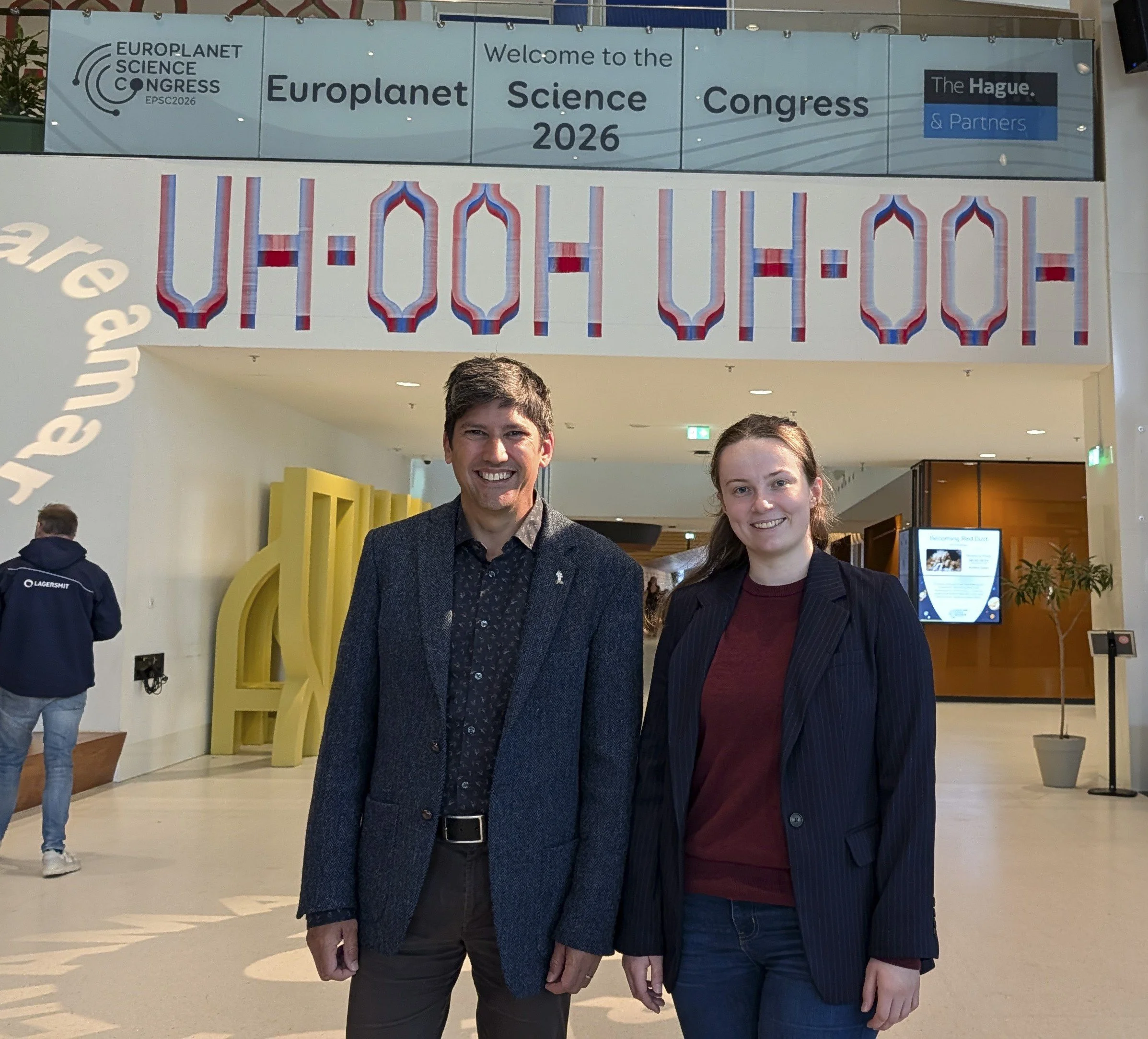
Richard with Eloise Crouch, who mapped the polygonal terrain on Venus for her undergraduate mapping project, at the Europlanet Science Congress in The Hague.
I read on your research profile that your expertise is in using remote sensing techniques (namely radar interferometry) to measure tiny changes in plate movements on Earth's surface. How did you come to apply similar methodologies to studying Venus?
My PhD research was investigating regional tectonic processes on Venus, and this is still my primary interest on Earth as well as Venus. Studying Venus necessarily involved understanding radar, and I was fortunate to start my career as those technologies developed and became a routine part of Earth Observation.
Since Venus is interesting but didn’t pay the bills, I pursued my other main interest in Engineering Geology and started to apply radar techniques, particularly persistent scatterer interferometry, to engineering problems, such as detecting the impact of dewatering and recharge on ground elevations. Amazingly, these techniques revealed a hitherto undetectable range of geological fault movements, giving us new insights into the deformation behavior of continental crust. I immediately realized the connection with Venus, and I proposed EnVision to use this technology at Venus to detect fault movements and other activity there, which would otherwise have been impossible from orbit.
In your recent EPSL paper, you argued that several features on Venus, including polygonal terrains and canali, could be remnants of ancient oceans. Is there a single piece of evidence that you find the most compelling, and why?
Many of my most significant discoveries have come from setting out to prove myself wrong. Being a uniformitarian, I had always thought that Venus never had oceans (not even early in its history), so I thought it would be straightforward to look for evidence of oceans and not find it. Tasking one of my students to go and look with unbiased eyes, I was stunned when she came back with a range of features.
For me, polygonal terrain is the ‘smoking gun’; it is almost impossible to generate it by volcanic or tectonic means, and every other way involves water. Realizing that meant accepting that Venus had oceans in the geologically recent past, and then many other oddities fall into place.
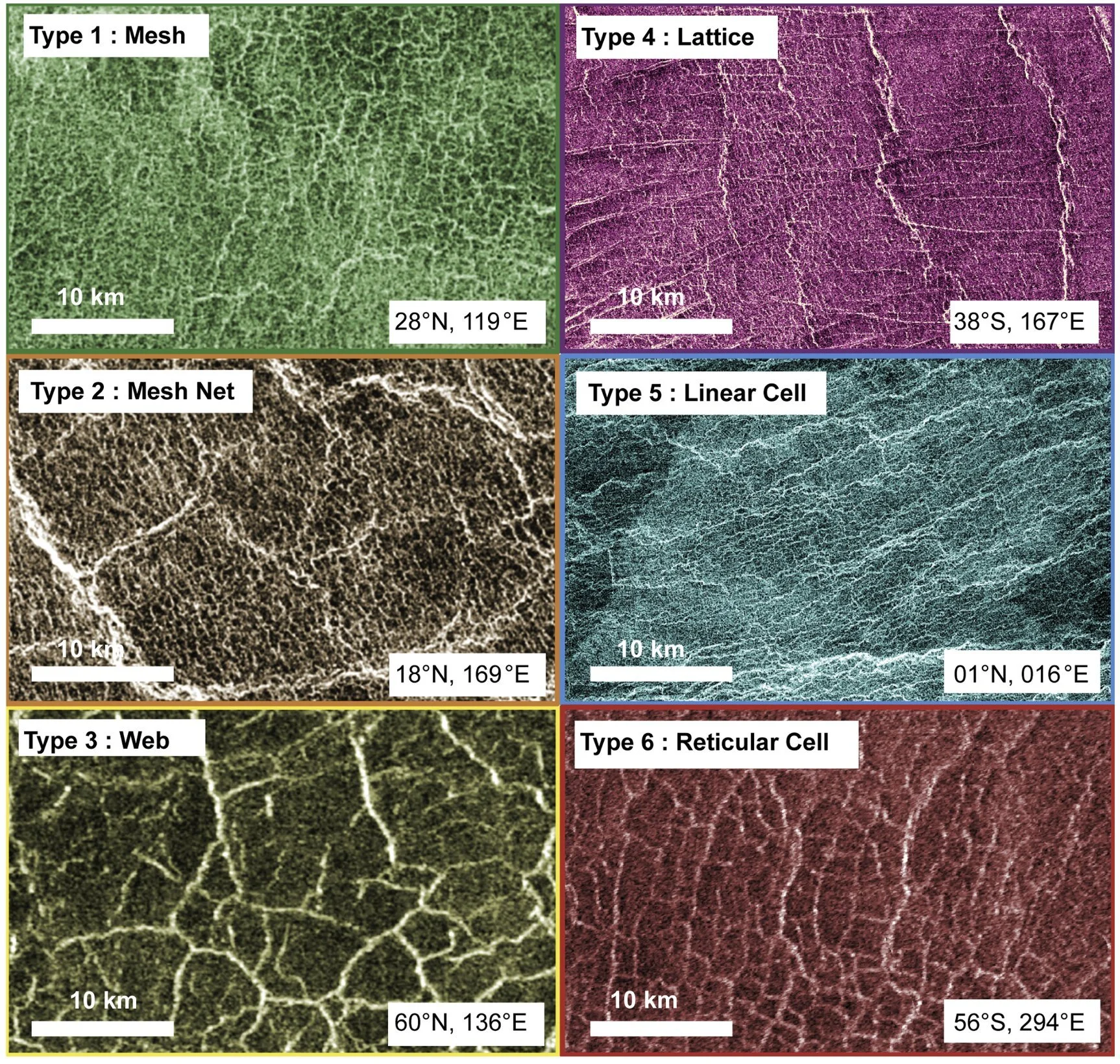
Examples of the six different types of polygons that Richard, Eloise, and colleagues identified on Venus, based on images from NASA's Magellan orbiter. Image via Earth and Planetary Science Letters (2026), CC BY 4.0.
On the flip side, what piece of evidence do you find the least convincing?
Decades ago, I was involved in research looking at whether canali on Venus are the remains of fluvial or submarine channels. While the evidence is consistent with that interpretation, canali can also equally plausibly be explained as carbonatite (volcanic) channels or density currents in the modern atmosphere. Given that alternate explanation, I abandoned the idea that Venus ever had oceans and felt that Occam’s Razor required accepting that Venus has always had a hot, dense atmosphere.
Do your results suggest Venus could have gone through a relatively Earth-like, temperate period before its climate tipped into the runaway greenhouse we see today, or do you think its planetary evolution was more complicated?
Michael Way’s models imply that an ocean-bearing Venus might have been a little warmer, but it was still fundamentally Earth-like. However, several factors led to the earlier demise of oceans on Venus than on Earth. Of course, Venus is closer to the Sun, and so increasing solar luminosity with solar age takes Venus across the threshold [to a runaway greenhouse] before Earth. However, the point of Michael Way’s research is that if you put Earth where Venus is [in the solar system], you still have Earth with oceans, so it’s not that simple.
It seems likely that the oceans on Venus were shallow, and so probably only a fifth to a quarter of the volume of Earth’s oceans. More importantly, I think the evidence points to Venus having a thicker mantle and smaller core than Earth, and consequently its mantle generates more heat than ours, effectively making Venus more like Earth was one or two billion years ago. Under those conditions, Venus is more likely to suffer regional mantle overturns in which multiple large igneous provinces erupt within a short period of time – a bit like the Cretaceous ‘superplume’ but worse. An effect like that would increase the greenhouse content of the Venus atmosphere by a factor of 10 or 20, triggering a runaway greenhouse earlier than might otherwise have been the case.
Even so, a runaway greenhouse is likely to be triggered on Earth within the next one or two billion years, from increased solar luminosity alone.
You mentioned the European Space Agency’s EnVision candidate mission to Venus, which you’re leading – what's the goal of that mission, and what type of data will it be collecting?
EnVision is designed to understand Venus from a holistic, Earth Observation-type approach, i.e., by looking at systems rather than features. It can’t do everything – for instance, NASA’s DAVINCI mission will measure isotopic ratios in situ, which EnVision can’t replicate. But it’s high-resolution radar imagery and polarimetry should resolve channels, shorelines, and other features that are at or beyond the limits of Magellan’s resolution.
Its suite of spectrometers will help us understand modern water and sulfur cycles and provide much better constraints on how volcanically active Venus is. These elements will help distinguish between different models of Venus’s history, including whether or not it once had oceans. The sounding radar offers perhaps the most exciting prospect, potentially being able to detect subsurface salt horizons left by the evaporated oceans. It’s not certain whether EnVision will be able to resolve these, but it would provide a much clearer picture of the past distribution of oceans on Venus if so.
What does this discovery mean for the possibility of past (or even present!) life on Venus?
Realizing that Venus had oceans within probably the last half billion years means that oceans existed there within the timescale of advanced life on Earth. While it’s intellectually interesting that Mars may have had primitive bacteria early in its history, it’s quite different thinking that our other neighbor may have had a complex, advanced biosphere, with Venusian equivalents of plants and animals, at a time when fish and land plants were evolving on Earth. It perhaps seems silly, but I felt a profound sense of grief thinking about that, and the sobering lesson that our beautiful, complex world could ultimately be sterilized by evaporating oceans.
On a separate and slightly more scientific – but highly speculative – basis, no one is entirely clear about how long it took for Venus to lose its oceans, but it might have been 100 million years or more. If it really took that long, it is entirely possible that some bacterial life adapted to the change and currently eke out a living in the cloud layer. I’m skeptical, but some scientists suspect it.