
Astrobiology Revealed #39: Shinya Kato
on prebiotic chemistry in auroral belts
by Aubrey Zerkle
For this Astrobiology Revealed, we asked Shinya Kato about his recent paper, “Auroral belts as magnetically localized reactors for prebiotic chemistry on early Earth.” Shinya is an Associate Professor at the Institute for Integrated Radiation and Nuclear Science, Kyoto University. He is also part of the Radiation Management laboratory, where he contributes to teaching and research in the Graduate School of Agriculture. Shinya discusses how auroral belts could have supplied reactive chemicals for early life at high latitudes. (This interview has been edited for length and clarity.)

I read in your bio that you proposed the new academic field of "Environmental Structural Ecology." How do you define that field, and how does it intersect with origins of life research?
In agriculture, water and nutrients alone are not enough. Light, soil, temperature, and other conditions also matter. I approach the origin of life from this agricultural perspective: understanding the environments that support life may help us explore the environments that first gave rise to it.
I proposed Environmental Structural Ecology as a field that seeks to understand how life works in relation to the organization of its surroundings. Where do materials gather, and how does energy reach them? Under what conditions could they begin to function as a living system? In this paper, I explore auroral environments as one possible setting.
In the paper, you argued that auroral belts could provide localized magnetic energy for prebiotic reactions. How do auroral belts form on Earth?
The energy for these reactions is delivered by charged particles, while Earth’s magnetic field helps guide where that energy is deposited.
The Sun releases a stream of electrically charged particles, including electrons and protons. This is the solar wind. Such a mixture of charged particles is called plasma. When the solar wind interacts with Earth’s magnetic field, particles around Earth can be accelerated. Some travel along magnetic field lines into the upper atmosphere at high latitudes. Their collisions with atmospheric gases produce the light we see as auroras.
These collisions also trigger chemical reactions. I call this setting a “natural ion-beam reactor,” although electrons also play an important role. On early Earth, it might have repeatedly produced some of the chemical building blocks of life.
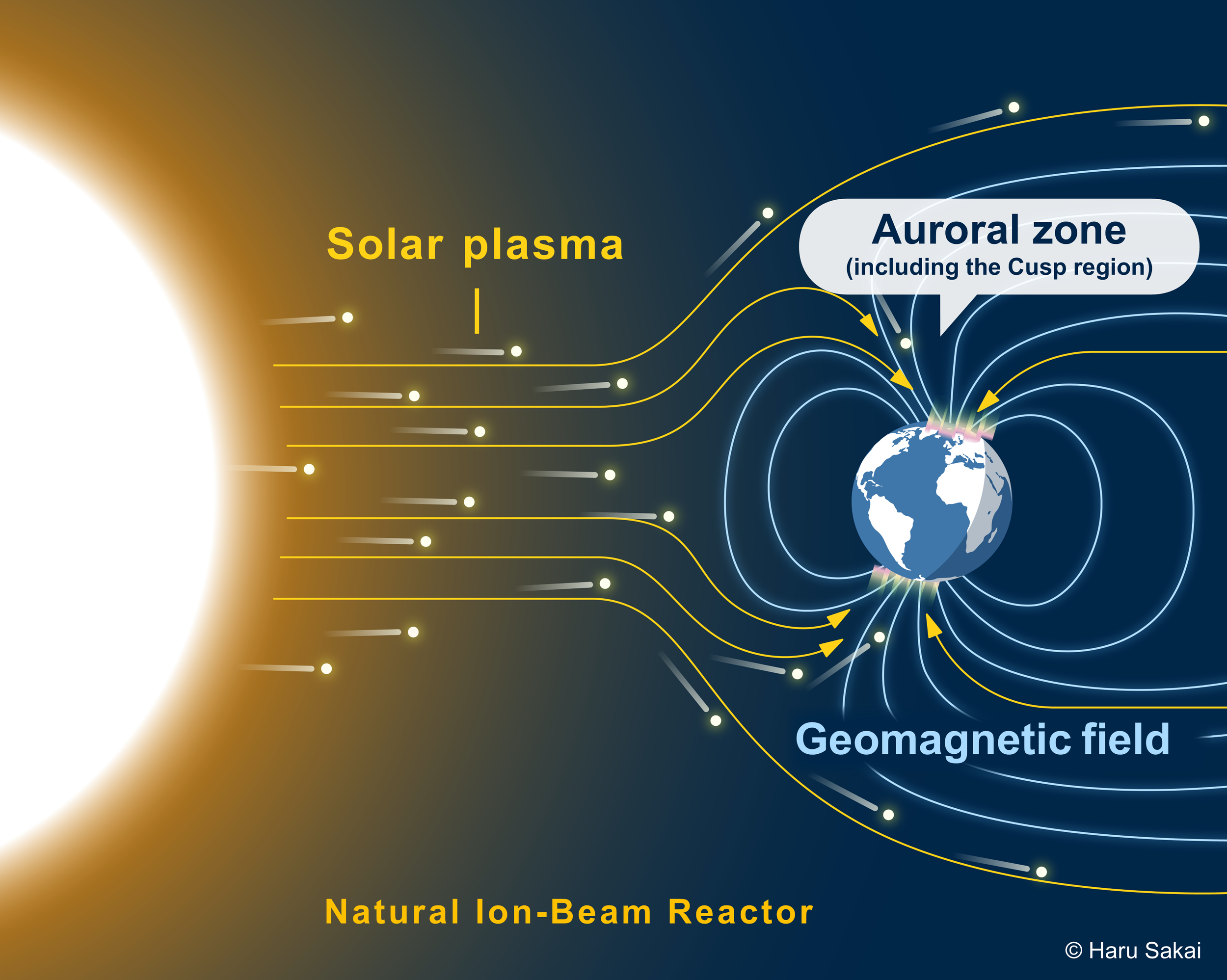
Figure 1. A simplified illustration of how interactions between the solar wind and Earth’s magnetic field deliver particle energy to the upper atmosphere at high latitudes. Illustration © Haru Sakai, used with permission.
Would these phenomena have been more or less widespread on the ancient Earth?
Possibly more widespread. The young Sun was more active than it is today, and Earth’s magnetic field may also have been different. These differences could have changed the regions where particles entered the atmosphere.
We do not yet know how extensive those regions were. My main interest is the mechanism that could have repeatedly delivered energy to particular places.
How did you first develop this hypothesis, and what encouraged you to pursue it?
This research began when I first arrived at my institute and lacked adequate laboratory space and the equipment I needed. But I did have time to think. Every day, I passed the research reactor on my way to work. One day, I found myself wondering, “People say life began in the sea—but which part of the sea?” Perhaps that question had been somewhere in the back of my mind since childhood.
The first people I shared this hypothesis with were my teacher at an English conversation school and another student. As an experimental scientist, I had never imagined that I could write a paper based on a hypothesis alone. But they listened with interest and encouraged me. Their encouragement helped me keep exploring that simple question, which eventually led to this paper. I learned how encouraging it can be when someone takes an interest in your ideas.
The crux of your argument seems to be that Earth's magnetic field can guide atmospheric particles into high latitudes, where amino acid precursors form. You suggested that this process could have provided a steady supply of prebiotic chemicals to restricted polar environments. How does that scenario fit in with current ideas about where life first evolved on Earth?
First, my paper proposes a hypothesis based on previous irradiation experiments; it does not demonstrate that this supply actually occurred. The particles involved would have arrived from the surrounding space environment and collided with atmospheric gases.
If chemical building blocks produced in the upper atmosphere reached the surface and gathered at boundaries between ice and water, further reactions might have taken place there. This idea could connect with research on chemistry in ice and with the idea that RNA played an important role in early life.
The place where the building blocks formed need not have been the place where life began. We still need to test how much material could have formed and how much could have reached the surface.
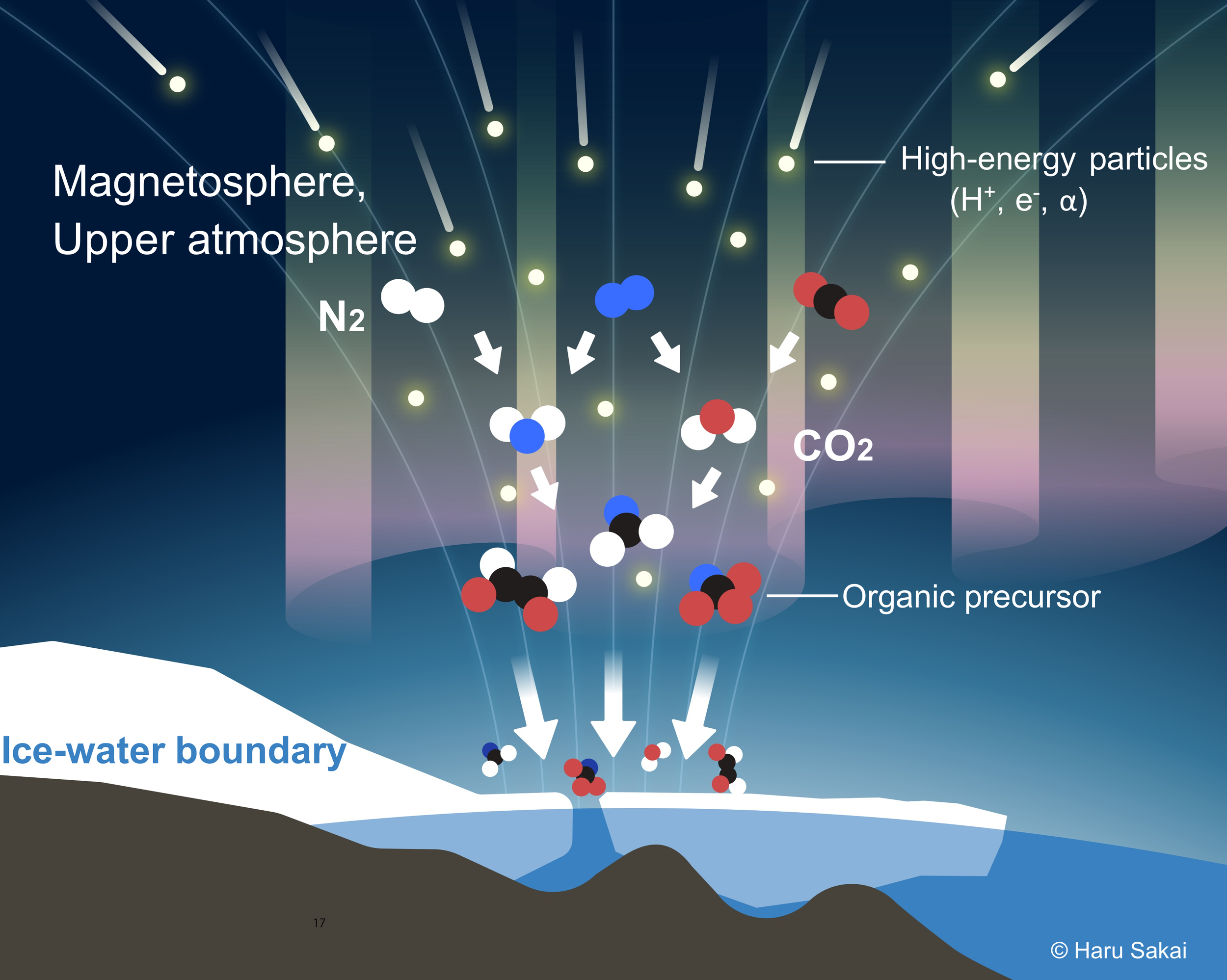
Figure 2. The proposed pathway by which organic compounds formed in the upper atmosphere reach the surface and gather at an ice–water boundary. The molecular drawings are schematic. Illustration © Haru Sakai, used with permission.
Could similar processes potentially fuel early life on other planets in our solar system, or even on exoplanets?
Similar processes could potentially support prebiotic chemistry elsewhere. On Saturn’s moon Titan, for example, light and particles drive atmospheric reactions that produce organic compounds. On Enceladus, particles interact with surface ice. Their magnetic and atmospheric environments differ from Earth’s, so the mechanisms are not identical.
Particles from stars could also drive chemistry on planets beyond our solar system. Studying where energy and materials gather, and where the resulting compounds survive, may help us understand the possibilities for life.
In the past few years, there seems to be a shift in origins of life research from global processes and energy sources to spatially localized ones. Why do you think that is?
We already know that some of life’s molecular building blocks can form without biology. The next question is: “So, when and how does this become life?”
I am interested in how a collection of molecules could become a system that maintains itself and acts on its surroundings. That makes places where materials gather and reactions continue especially important. I think this is one reason localized environments are attracting attention.
How would you go about further testing this idea?
I want to understand the principles behind the emergence of life-like behavior and develop experimental methods to investigate them.
First, I plan to expose molecules relevant to life’s functions to radiation and study what happens during repeated freezing and thawing. I am particularly interested in whether this produces molecules that are “stable enough”—able to persist while still changing.
To explore the conditions under which life-like behavior might emerge, I also want to pay attention to chance reactions and molecular combinations that arise over many repeated cycles.