How to Cook a Prebiotic Soup
An introduction to Maillard Reaction
This article was originally published by Olga Taran on Prebiotic Alchemy on 30 November of 2025. Read the original →
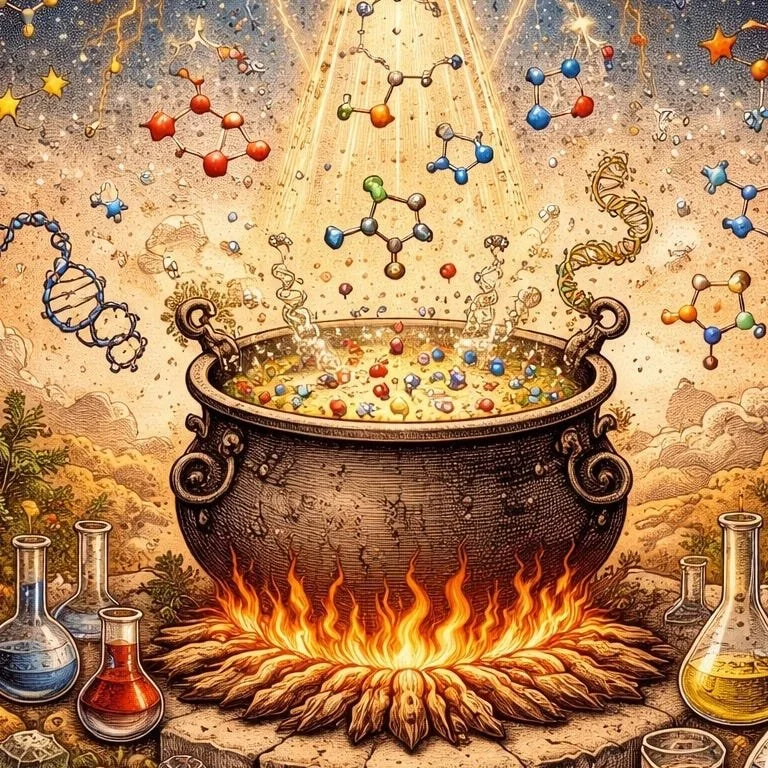
This week in US we celebrated Thanksgiving. So some musings about Maillard reaction seem appropriate. It is called the most popular chemical reaction in the world, performed daily in every kitchen. The Maillard reaction is the reaction between amines and sugars found in food, which takes place when the temperature is raised over 50C and is responsible for the smells and flavors of the cooked meals. Everybody has done it, and often, the invention of cooking is considered a major event in human evolution. Stay with me, and I will show you that “kitchen chemistry” might be one of the best clues we have about early ‘prebiotic soups’ and the origin of life.
“Maillard Reaction” became almost a household name about a decade ago, when everybody was into molecular gastronomy, but the reaction itself is more than 100 years old. In the early 1910’s, when nucleic acid and biopolymers chemistry was virtually unknown, Maillard tried to synthesize biomolecules by mixing sugars and amines. The result of the reaction was a brownish product that “smelled good”. With the rise of food chemistry industry, starting in the 1950ies the reaction was studied extensively, with isolated and resynthesized product of the reaction being responsible for the smell, flavor and color of modern ultra-processed foods and meat substitutes.
Despite huge practical applications, the understanding of the reaction mechanism still seems to be “complex”: amines react with carbonyls, forming imine adducts, which lose water and break into reactive dicarbonyl compounds, those react with more amines or thiols. Once a length of 5-6 carbon molecules is reached, cyclic compounds are formed, including phenazines, quinones and other structures known from electron transport systems in cells. Those compounds once again react with the rest of the products, now adding redox chemistry to the mixture. Once more and more water is removed from the sugar molecules, aromatic molecules start forming brown polymers called “melanoidins” which, eventually get glued together to create black char of the burned food. The colors of the reaction usually go from yellow and oranges to reds and browns, but also sometime green, when sulfur-containing amino acids, such as cysteine are used or even blue, if pH is basic enough.
Systematic studies often suggest to start from simple molecules and build up in complexity. That seemingly reasonable solution often leads to decision paralysis – what are the good starting molecules from the seemingly infinite number of combinations we know? Curiously enough, we seem to know more about the Maillard reaction products from our intuitive cooking strategies, rather than from carefully designed experiments. For example, addition of the salt crust to food reduces water activity and accelerates the formation of cyclic products. Monosodium Glutamate, an amine, facilitates the reaction with fatty acids. Addition of garlic and onions introduces sulfur-rich compounds, which lead to the formation of larger variety of heterocyclic aromatics containing sulfur group and resembling biotin cofactors found elsewhere in the living cells. Adding too much vinegar to muffins makes them stay white, by decreasing the rate of the reaction, but overdoing it with the baking soda can increase the pH and lead to dark brown crust. We know that at some point hydrogen peroxide is formed in the reaction and some kind of ROS regulation of the reaction products exists, but I could not find a satisfactory mechanism of the reaction.
For a long time it has been assumed, that the reaction is restricted to the kitchen, because heating is a necessary step fro the products to appear. Recently it has been confirmed that iron and manganeses, common elements of mafic rocks of ocean crust, can accelerate the reaction even in cold oceanic waters. Maillard reaction takes place at the bottom of the ocean, where the carbonyl compounds are converted into insoluble organic matter that can be buried in the ocean crust, and is one of the still poorly understood carbon sinks, or places for the long term storage of CO2. It has been suggested, that Maillard reaction was responsible for the slow removal of CO2 from the early atmosphere and would be one of the factors contributing to the Great Oxygenation Event”. UV light also seem to play at least some role in the reaction and Maillard reaction products are also found in the atmosphere, accumulated as ‘brown carbon’, which creates a haze that contributes to the overall temperature increase of the planet. It does not sound like a good thing today, but it might have been important in the temperature raise on the Early Earth and creation of the liquid water environments that can host life.
With all these mentioned, it is surprising that the reaction seem to be understudied by the origin of life community. There was some interest in the nitrogen containing heterocyclic compounds formed as a product of the reaction early on by Joan Oro, about 50 years ago. There is a paper written almost 20 years ago, where the products of all canonical amino acids and ribose are synthesized and the profile of the products is compared to the composition of carbonaceous chondrite meteorite, and finding them rather different. Currently, there is a renewed interest in the Maillard reaction as a route to pyridines and purines, where it becomes just one of many other routes previously studied.
Unfortunately, with a narrow focus on nucleotide and peptide synthesis that seem to dominate research in prebiotic chemistry, there is little interest in synthetic routes to the “secondary metabolism” compounds. Who wants to be considered “secondary”, anyways? That makes a lot of prebiotic chemistry rather dull for the senses: most of the reactions you can see in the lab are just rows of vials with transparent solutions of peptides and nucleotides. We like starting simple and having predictable outcomes, because it seems “reasonable” and “logical”. Maillard reaction seems to unruly, too much like “cooking” the prebiotic soup.
Can it be just the lack of imagination? Maybe life did not start as a transparent goo of peptides and nucleic acids writing a code, but first erupted in the bright colors of cofactor chemistry, which also “smelled rather well”?
Read more posts like this at Prebiotic Alchemy