Astrobiology Revealed #35: Ana Miller
on the microbial ecology of Mars-analog lava tubes
by Aubrey Zerkle
In this Q&A, we asked Ana Miller about her recent paper “The Microbial Inhabitants of the Corona Lava Tube: Astrobiological Insights from a Mars Analog Environment.” Ana is a Senior Scientist at the Institute of Natural Resources and Agrobiology of Seville, part of the Spanish National Research Council (IRNAS-CSIC), where she leads the Geomicrobiology and Biogeochemistry research group, BIOGEOCOM. Ana explains why the Corona Lava Tube System in Lanzarote is an extraordinary natural laboratory for astrobiology and how ESA is using it to train astronauts to detect signs of life on Mars. (This interview has been edited for length and clarity.)
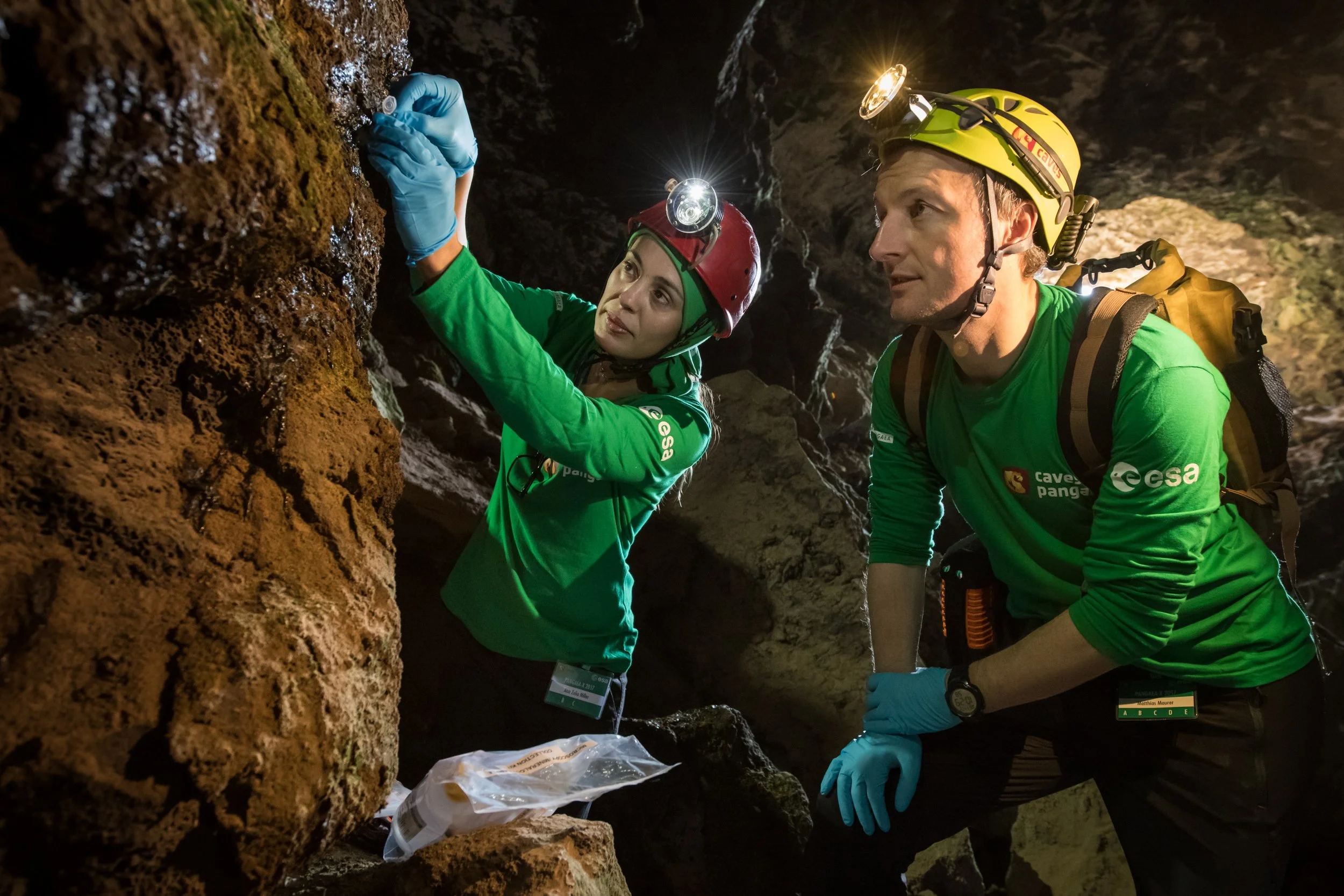
Sampling inside the Corona Lava Tube during ESA's PANGAEA-X campaign: geomicrobiologist Ana Zélia Miller and ESA astronaut Matthias Maurer collect samples for subsequent analysis inside the cave. Photo by Robbie Shone - ESA.
I read that the BIOGEOCOM research group is dedicated to "exploring the interactions between microorganisms, minerals, and organic matter in complex environments" using a range of interdisciplinary methods. How did you come to apply this approach to the field of astrobiology?
My background is in conservation science, where I initially studied how microorganisms colonise and alter stone monuments and caves. This led me to investigate the broader interactions between microorganisms, minerals and organic matter in subterranean environments. Understanding these complex systems requires combining microbiology with microscopy, mineralogy and geochemistry.
When I began working in volcanic caves, the astrobiological connection became clear. These nutrient-poor environments provide natural laboratories for studying how life survives under extreme conditions and what traces it may leave behind. This interdisciplinary approach is now central to BIOGEOCOM's research.
Your recent paper in Astrobiology focuses on the microbial ecology of the Corona Lava Tube System in Lanzarote. How is this system a good terrestrial analog for Mars?
The Corona volcanic system in Lanzarote is one of the most spectacular lava tube systems in the world and an extraordinary natural laboratory for astrobiology. It shares several characteristics with the lava tubes that we expect to find on Mars: it reaches impressive dimensions, with some passages up to 20 metres in diameter, and remains exceptionally well preserved and relatively undisturbed. It is also located in an arid volcanic landscape with little soil and limited organic inputs.
Its dark, nutrient-poor passages contain mineral deposits and microbial communities adapted to very specific environmental constraints. Lava tubes on Mars could provide protection from radiation, extreme temperature variations and harsh surface conditions. These characteristics make Corona one of the best terrestrial analogues for investigating how microbial life colonises volcanic subsurface environments and how its biological, chemical and morphological signatures may be preserved.
This work was part of the European Space Agency's Planetary Analogue Geological and Astrobiological Exercise for Astronauts (PANGAEA) astronaut training program, which sounds thrilling! Can you tell us a bit about what that entailed?
PANGAEA is ESA’s astronaut training program in planetary geology and astrobiology, designed to prepare astronauts for future missions to the Moon and Mars. They learn to recognise different rocks, identify sites of geological or biological interest, select the most informative samples and make scientific decisions in real time.
PANGAEA-X, conducted in Lanzarote in 2017, extended this training by testing technologies and scientific procedures in Mars-analogue volcanic environments. It was an extraordinary experience that brought together astronauts, scientists, engineers, speleology, and cutting-edge technology to simulate a mission searching for microbial life inside a lava tube. I worked with ESA astronaut Matthias Maurer to collect samples and analyse their DNA inside the Corona Lava Tube. Bringing part of the laboratory directly into the cave allowed us to obtain results in near real time. This is particularly important because returning samples from Mars would be extremely complex, costly, and time-consuming, so future explorers will need to take part of the laboratory with them.
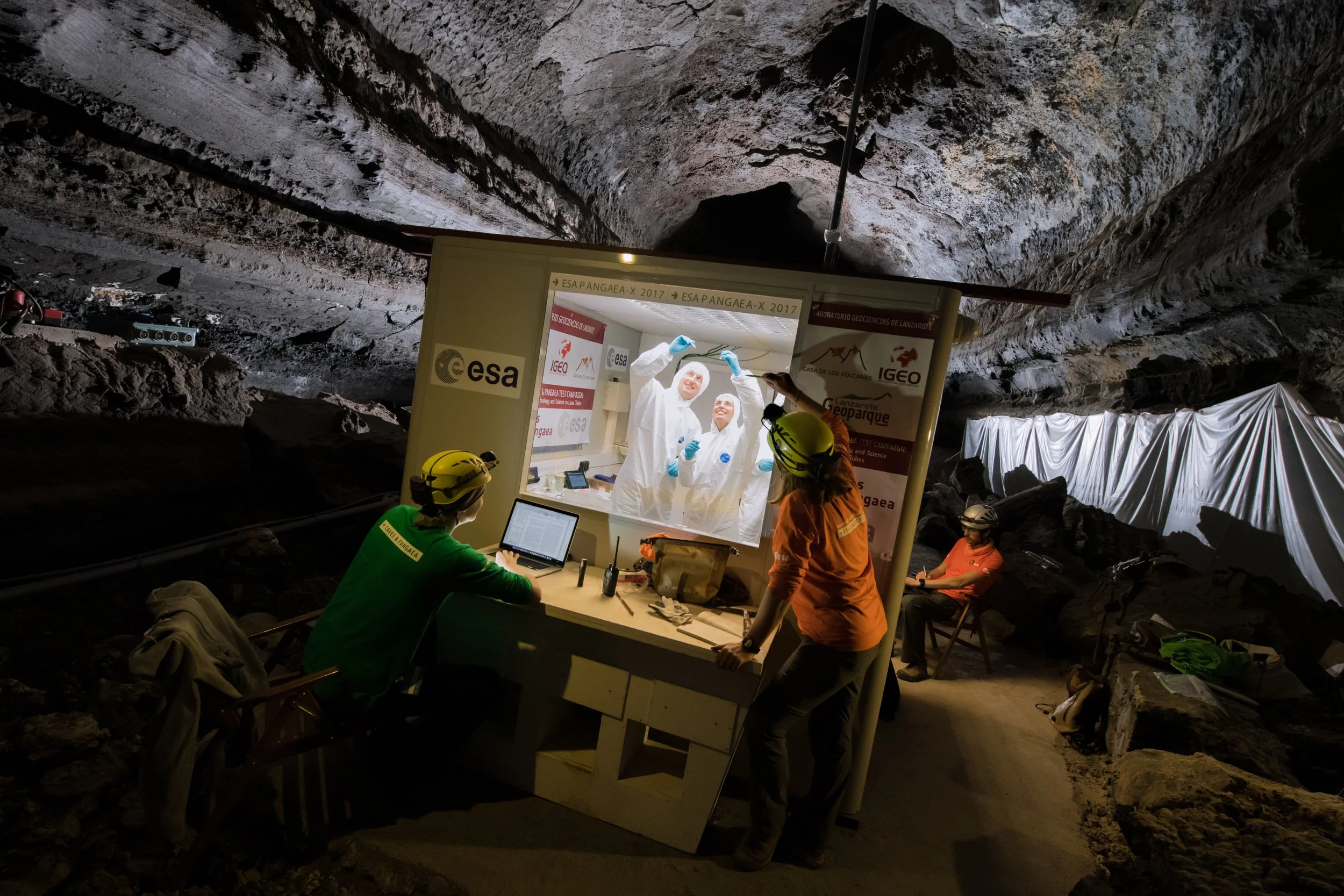
Cave-based laboratory module where real-time DNA sequencing was performed. Photo by Robbie Shone - ESA.
You examined samples from the lava tubes using a variety of microbial, mineralogical, and geochemical analyses, spanning the gamut of astrobiological methods. What did you find to be the most challenging aspect of the project?
The greatest challenge was conducting a complex microbiological investigation under field conditions while working within strict conservation and contamination-control requirements. We had limited samples, low microbial biomass, and only portable equipment inside a dark cave environment. We also wanted to obtain useful sequencing information rapidly, as would be necessary during a planetary mission.
A second challenge was integrating the microbiological results with mineralogical, microscopic, and organic geochemical evidence to understand not only which microorganisms were present, but also their relationship with the cave materials.
What was the most surprising result you found?
One particularly surprising result was the strong connection between vegetation at the surface and the black organic coating found inside the cave. Our analyses indicated that latex from Euphorbia balsamifera (a flowering plant) had entered the lava tube and provided an organic-rich substrate for microbial colonisation. We detected salt-tolerant bacteria and microorganisms associated with the transformation of hydrocarbons in this material.
In contrast, the gypsum deposits contained very little organic matter, yet microorganisms had left visible microborings and etching patterns on the mineral surfaces. These two microhabitats preserved very different types of biosignatures.
What would you say is the most important takeaway from your results for astrobiologists looking for life in similar cave systems on Mars?
There is unlikely to be a single universal biosignature or ideal sample. Even within the same lava tube, neighbouring microhabitats can differ greatly in mineralogy, organic content and microbial colonisation. In organic-poor deposits, molecular biomarkers may be scarce, but mineral surfaces can still preserve physical traces of microbial activity.
Future exploration should therefore combine geological context, mineralogy, microscopy, organic chemistry and biological analyses. Portable instruments can help identify promising samples in real time, but evidence from several complementary techniques will be essential for interpreting any potential signs of life.
Is there anything else you’d like to discuss that I haven’t asked you about?
The value of planetary analogue sites lies in allowing us to test hypotheses, instruments and operational procedures under realistic constraints. Our study also highlights the importance of protecting terrestrial lava tubes, which are scientifically valuable and often fragile ecosystems. For students and early-career researchers, this work illustrates how astrobiology benefits from collaboration across microbiology, geology, chemistry, engineering and planetary science.